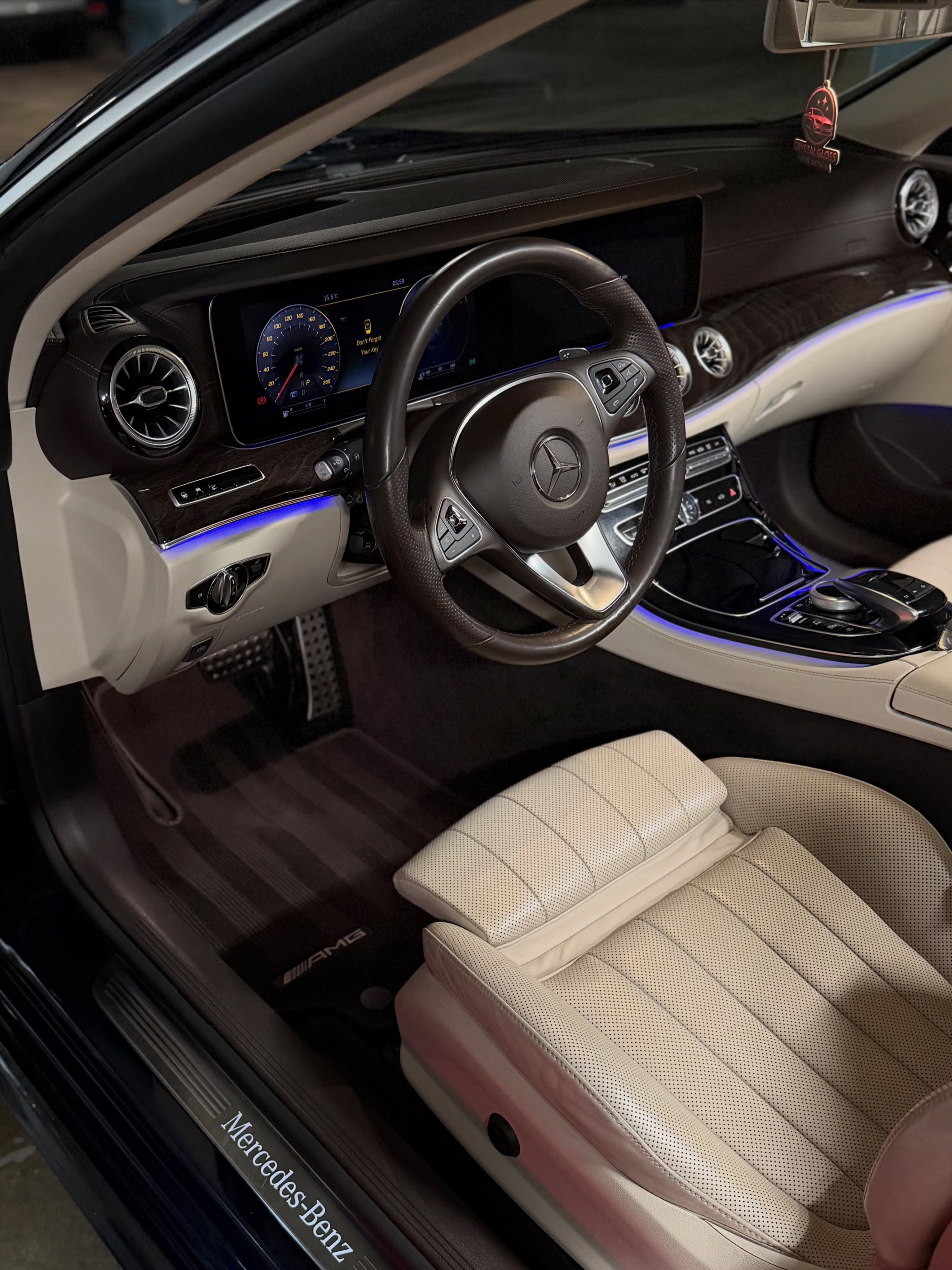
That haze on the inside of your windshield is dashboard off-gassing, and it's why your defroster leaves streaks. How to check it and how to clear it.
It's 7am, it's four degrees, and you're sitting in your driveway on Burke Mountain waiting for the windshield to clear. The defroster has been running three minutes and all it's done is turn the fog into streaky arcs you have to peer between. Then you pull onto the Barnet into low sun and the whole windshield goes milky.
That's not the glass being old and it's not your defroster failing. There's a film on the inside of the windshield, it's been building all summer, and winter is just the season that makes it obvious.
This post covers where the film comes from, four checks to confirm it, and why glass cleaner usually makes it worse. One thing up front: we clean glass, we don't repair it. If the glare is coming from fine scratches rather than film, no amount of cleaning fixes that.
What's actually happening
- Your dashboard is the source. Interior plastics contain plasticizers to keep them flexible. When the cabin heats up in the sun, those compounds vapourize and migrate, and they condense on the coolest large surface at the right angle — which is the windshield, raked back directly above the dash.
- That's why it's an oily film, not dirt. It doesn't rinse off and it doesn't blow off. It's a thin layer of plastic residue chemically stuck to the glass.
- Winter reveals it rather than causing it. Cold glass plus warm humid cabin air means condensation. Water condenses onto the film instead of onto clean glass, so instead of an even sheet that clears evenly, you get patchy haze with smeary edges. The pattern your defroster leaves is the film.
- Vaping and smoking accelerate it hard. Vape glycerin in particular is sticky and holds moisture, which makes the film worse at fogging than a plain plasticizer haze.
- Dash dressings and air fresheners add to it. Anything oil-based sprayed inside a closed cabin ends up on the glass eventually.
- Running the defroster on recirculate keeps the moisture in. You're pushing the same humid cabin air back against cold glass instead of replacing it with dry air from outside.
Where it shows up
- The windshield interior, worst across the bottom third nearest the dash and again up where the glass rakes back.
- The rear window interior, same mechanism off the rear parcel shelf.
- Side windows, less so — they're more vertical and further from the dash.
- The inside of the rear-view mirror, which people clean last and which has the same film on it.
- The instrument cluster lens and the infotainment screen, which go hazy from the identical process.
A five-minute check
Four tests. One of them you can only do on a cold morning, so start there.
- Watch what the defroster leaves. On the next cold morning, run the defroster and watch how the fog clears. Clean glass clears as an even, advancing edge. Filmed glass clears in patches and leaves arcs and streaks behind. If there's a pattern, there's film.
- The low sun test. Sit in the driver's seat facing into low morning or evening sun and look through the glass, not at the road. Film shows up as a milky veil across the whole windshield. Clean glass is invisible.
- The split test. Clean one square foot in the middle of the windshield properly — one barely damp microfiber to lift, one clean dry one to buff. Then look at it against the glass around it. A visible boundary means the rest of the windshield is filmed.
- Wipe the top of the dash with a clean white cloth. If the cloth comes away with an oily sheen, the source is still active. That tells you the film will come back after you clean the glass, and it tells you the dash needs cleaning too, not just the windshield.
Test 4 is the one that decides whether cleaning the glass is going to hold. Clean glass above an oily dash is a two-month fix.
What you can do this week
- Use two cloths, every time. One barely damp to lift the film, one clean and dry to buff it off before it dries. One cloth just moves it around, and paper towel moves it around while shedding lint into it.
- Skip the ammonia glass cleaner on a heavily filmed windshield. It emulsifies the oil and spreads it thinner across a wider area, which is exactly the streaky arc everyone blames the cleaner for. A little isopropyl alcohol on a microfiber cuts the residue properly instead. Keep it off tinted glass and off plastics and screens.
- Stop spraying dressing on the top of the dash. If you use a product, spray the cloth and wipe, and leave the upper dash out of it entirely.
- Run the defroster on fresh air with the A/C on, not recirculate. The compressor dries the air, and fresh air replaces the cabin humidity rather than recycling it. It feels wrong in winter and it works.
- Get the wet floor mats, the damp gym bag and the wet umbrella out of the car. Cabin humidity is what turns an invisible film into a fogged windshield.
- Crack two windows for a few hours on any dry day.
Cleaning the glass treats the symptom. If the dash keeps off-gassing and the cabin keeps carrying moisture, the film comes back — slower if you've cleaned the dash too, faster if you haven't.
When it needs a professional
Two cloths and some alcohol are enough when the film is light and the dash test comes up clean. That's a fifteen-minute job in your own driveway and you shouldn't pay anyone for it.
It needs an interior detail. When the film has been building for years, when there's a smoking or vaping history in the car, when every attempt at the glass leaves streaks, or when the white cloth on the dash comes up oily — the glass can't be fixed on its own. The surfaces feeding it have to be cleaned at the same time, in the right order, or you're cleaning a windshield that gets re-coated from below.
It's past us. Glass that's been wiped dry with paper towel and grit for years carries fine scratches, and scratched glass scatters light exactly like film does. Cleaning changes nothing. The way to tell is simple: if a properly cleaned test patch still glares in low sun, the problem is in the glass, and that's a glass shop. The same goes for haze between the laminate layers of an old windshield, which nothing applied to either surface will reach.
What an interior detail visit does
We're fully mobile across the Tri-Cities — Burke Mountain, Westwood Plateau, Austin Heights, Maillardville, Como Lake. Driveway, office lot or building parkade, and we bring water, equipment and lighting with us. You don't drive anywhere.
Order matters more on this job than most. Glass goes last. Everything gets vacuumed, every surface hand-scrubbed including the cracks and crevices, surfaces conditioned, and only then is the glass done streak-free — because cleaning a dashboard after the windshield puts a fresh film straight back onto clean glass. Then door jambs and the trunk jamb. A few hours, depending on size and condition.
Which visit matches
| What you're seeing | Best fit |
|---|---|
| Light haze, dash cloth comes up clean | Do it yourself — two cloths and some alcohol |
| Film plus an oily dash, streaks every time you clean the glass | Interior detail — From $240 |
| Smoking or vaping history in the car | Interior detail — From $240 |
| Hazy cluster lens and screen along with the windshield | Interior detail — From $240 |
| A properly cleaned test patch still glares in low sun | Not us — glass shop. That's scratches, not film |
Quick answers
How much is an interior detail in Coquitlam?
From $240, depending on the size of the vehicle and its condition. No travel charge in Coquitlam, Port Coquitlam or Port Moody.
Why does my windshield streak no matter what glass cleaner I use?
Because most glass cleaner emulsifies the oily film on the inside of the glass and spreads it rather than removing it. Two cloths — one barely damp, one dry to buff — and isopropyl alcohol instead of ammonia is the fix.
Will interior windshield film come back after cleaning?
Yes, eventually — the dashboard keeps off-gassing for as long as you own the car. Cleaning the dash at the same time as the glass is what makes the difference between a few months and a couple of years.
Can you detail a car in my building's parkade?
Yes. Most of our Coquitlam and Port Moody bookings are parkade or driveway jobs. We just need room to open the doors.
Do I need to be home for a mobile interior detail?
No, as long as we can reach the car and get into the building if it's a parkade.
How to book
- Call or text (778) 656-2947, or request a quote on the site.
- Tell us the vehicle and whether the dash test came up oily or clean.
- We confirm a time and an address, driveway or parkade.
- We show up with water, equipment and lighting, glass goes last, and you can see through your windshield again.