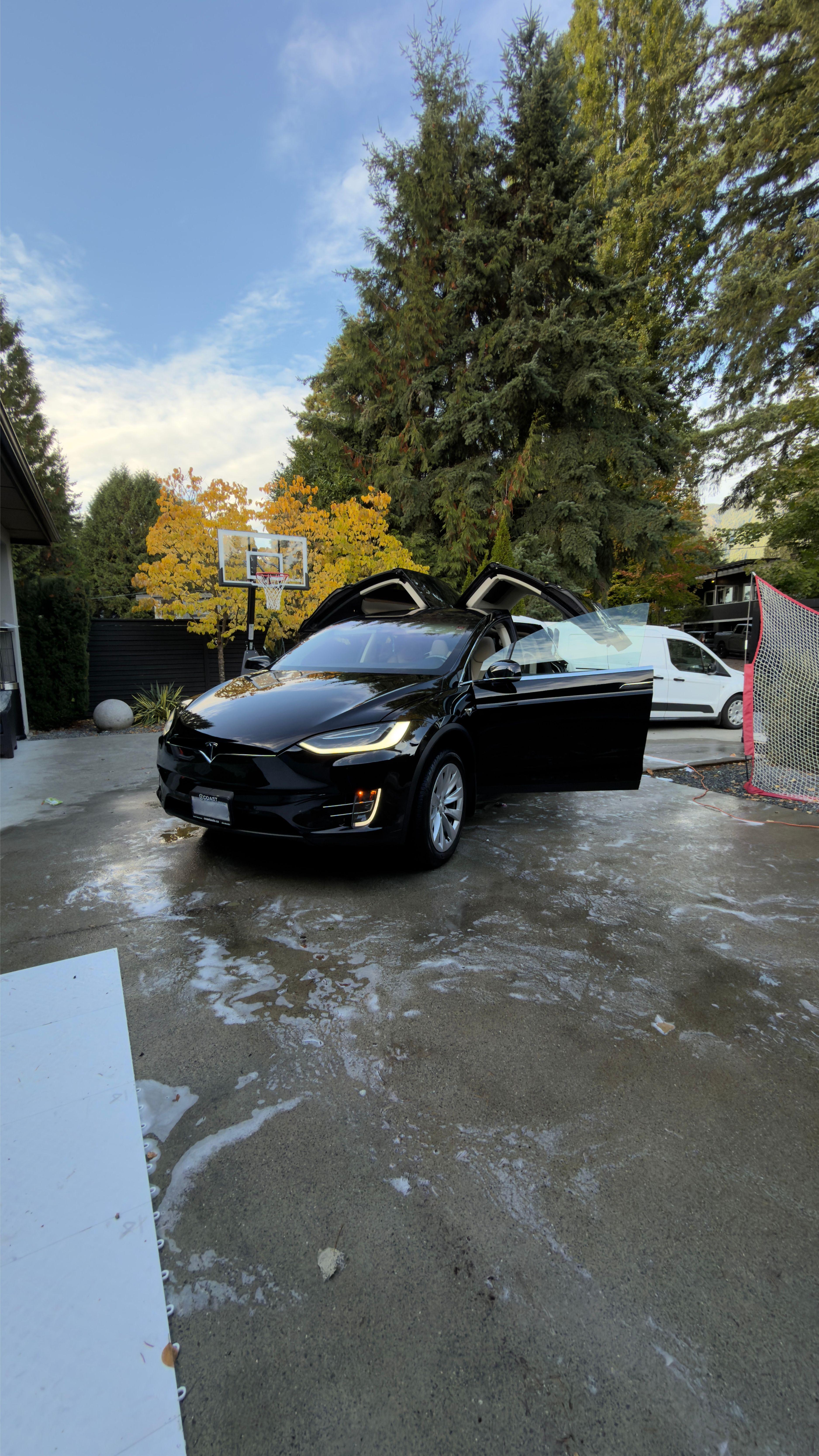
Gravel shoulders, conifer sap, farm traffic and more rain. Your car accumulates faster out here than one parked downtown — and here's what that means.
Park two identical cars for a month, one in Albion and one in Kitsilano, and they will not be in the same condition at the end of it. The Maple Ridge one will be visibly worse, and it isn't because people out here wash their cars less.
It's because the inputs are different. Six of them, and they stack.
This post covers what those are, five things to check on your own car, and why the wash routine that works for someone downtown doesn't hold out here. Up front: we clean and maintain paint. We don't repaint panels, and sap that's already etched through the clear coat is past anything we do.
What's actually happening
- Gravel shoulders and unpaved edges. East of 240th, up through Silver Valley, Whonnock, Websters Corners and Thornhill, a lot of road edge isn't curbed. Every pass throws grit at your lower panels. Vancouver is almost entirely curbed and swept.
- Driveway parking instead of a parkade. Most of Maple Ridge parks outside, under or near trees, 24 hours a day. Most of central Vancouver parks underground or on managed streets. A car that lives outdoors collects sap, needles, bird droppings and leaf tannin continuously.
- Conifers. Cedar, fir and hemlock drop needles and sap year-round rather than in one autumn burst, and big-leaf maples drop tannin-heavy leaves that stain when they sit wet. That's a different fallout profile from a managed downtown street tree.
- Farm and construction traffic. The ALR land through Maple Ridge and Pitt Meadows puts tractors, soil trucks and field-entrance mud onto public roads, and the growth in Albion and Silver Valley adds construction traffic on top. That mud gets tracked out and then everyone drives through it.
- Longer commutes. A downtown resident might drive ten kilometres a day. A Maple Ridge commuter does several times that on the Lougheed, the Golden Ears and the Mary Hill. More kilometres means more road film, more brake dust and more winter brine.
- More rain. Sitting at the base of the Golden Ears, Maple Ridge reliably gets more precipitation than downtown or the airport — the mountains force the air up and it drops its water here. More rain means more road spray, more time spent wet, and more organic growth on anything parked outside.
Individually none of those is dramatic. Together they mean your car accumulates faster than the same car parked downtown — and that's the part that actually matters, because it changes what a sensible maintenance interval looks like.
Where it shows up
- The roof first, not the hood. Tree fallout lands on top, and the roof is the panel nobody looks at.
- The cowl — the plastic grille at the base of the windshield. Needles and leaf matter pack in, block the drain, and hold water right above your cabin air intake.
- Window seals, wiper arms and rubber trim, where a green algae film builds up in wet shade.
- Behind the wheels and in the arch liners, packed with gravel grit.
- The underside, which nobody sees and which takes everything the roads throw up.
A five-minute check
Five things, in your driveway, right now.
- Open the hood and look at the cowl. That plastic grille at the base of the windshield fills with needles and leaf matter, the drain blocks, and then water sits there — directly above where your cabin air comes in. Almost nobody checks it and it's the most consequential thing on this list.
- Look at the rubber seals and wiper arms for a green film. That's algae, and it's the signature of a car that lives outdoors in a wet climate. It holds moisture against the paint and the rubber underneath it.
- White cloth test on the roof, not the hood. Wipe one damp pass. The roof shows tree fallout months before the hood does.
- Run a fingernail across the roof and hood for tacky spots. That's sap. It isn't dirt, it won't wash off, and it keeps curing and hardening the longer it sits.
- Reach up behind a front wheel into the arch liner. Packed grit there is the gravel-shoulder tax, and it stays wet against the metal all winter.
Test 1 is the one worth doing even if you skip the rest, because a blocked cowl drain eventually becomes a wet carpet and a musty cabin, and by then you're chasing a smell instead of clearing a grille.
What you can do this week
- Move where you park, if you have any choice at all. Getting out from under one tree makes more difference than anything else available to you, and it costs nothing.
- Clear the cowl. Lift the wiper arms, pull the needles and leaf matter out, make sure water runs through.
- Rinse more often than you think you need to. The honest version: a schedule that keeps a downtown car looking fine will lose ground on a car parked in Albion. Not because you're doing it wrong — because there's more landing on it.
- Deal with sap quickly. It etches as it cures. Fresh sap comes off easily; six-month-old sap sometimes doesn't come off at all.
- Don't let needles sit in seams and seals. They hold water exactly where you don't want it.
All of that slows accumulation. None of it changes the rate at which stuff lands on your car, because that's a function of where you live.
When it needs a professional
Washing it yourself is enough when the contamination is recent and loose — dust, fresh fallout, road film. Rinse it, you're fine.
It needs a detail. When contamination is bonded, when there's cured sap or tannin staining from leaves that sat wet, or when the arch liners and seals have years of build-up — that's chemistry and time, and it's a reset rather than a wash. See our full detail and interior detailing pages for what a full reset covers.
It's past us. Sap or tannin that has etched down into the clear coat leaves a mark that cleaning won't lift. That's paint correction if it's shallow, and a refinisher if it isn't. We'll tell you which at the driveway rather than sell you a detail that won't fix it.
What a maintenance plan does
This is the part the whole post is actually about.
If your car accumulates faster than a car parked downtown, then the interval that works downtown doesn't work here. Most people respond by washing occasionally, falling behind, and eventually paying for a big reset once a year — which costs more than staying on top of it ever would have.
A maintenance plan is just the schedule the conditions actually call for. We come to you on a set frequency, do the same work every visit, and the car never gets far enough behind to need rescuing. Driveway, office lot, wherever it is — you don't have to be home, and you don't have to remember.
What Crystal Gloss Auto Detail charges
- Maintenance plans are quoted per vehicle, based on size, where it's parked, how it's used, and how often you want us
- Visits are scheduled in advance and billed on the plan, not per job
- No travel charge in Maple Ridge or Pitt Meadows
One limitation, said plainly. A plan is maintenance, not restoration. If the car is already well behind — bonded contamination, cured sap, years of build-up — it needs a reset detail first, and then the plan holds it there. Starting a plan on a neglected car just means paying a maintenance price for restoration work, and it won't catch up.
Which visit matches
| Where you're at | Best fit |
|---|---|
| Car's in decent shape, washed recently | Nothing needed — keep rinsing |
| Parked under trees, washing occasionally, slowly losing ground | Maintenance plan |
| Visibly behind — bonded contamination, build-up in the seals | Reset detail first, then a plan |
| Sap or tannin etched into the clear coat | Different service — see paint correction |
| Clear coat peeling or failed | Not us — refinisher |
Quick answers
How much is a car detailing maintenance plan in Maple Ridge?
Plans are quoted per vehicle, based on size, where the car is parked, how it's used and how often you want service. No travel charge in Maple Ridge or Pitt Meadows.
How often should a car in Maple Ridge be detailed compared to Vancouver?
More often. Gravel shoulders, conifer fallout, farm and construction traffic, longer commutes and higher rainfall all mean a car accumulates contamination faster in Maple Ridge than one parked in central Vancouver.
Do I need a full detail before starting a maintenance plan?
If the car is already well behind, yes — otherwise you're paying maintenance rates for restoration work and never catching up. If it's in reasonable shape, we start straight on the plan.
Do I need to be home for a maintenance plan visit?
No. Most plan visits happen with nobody around, which is the point of it being on a schedule.
Can I pause a maintenance plan in the summer?
Yes. Most people actually want the opposite, since winter is when the car falls behind fastest.
Stay ahead of it instead of catching up once a year
Nothing about where you live is going to change. The trees, the gravel, the rain and the commute are all staying exactly where they are. The only variable you control is whether the car gets attention on a schedule or once it's already bad.
Call or text (778) 656-2947, or request a quote. See all plan options on the maintenance plans page.