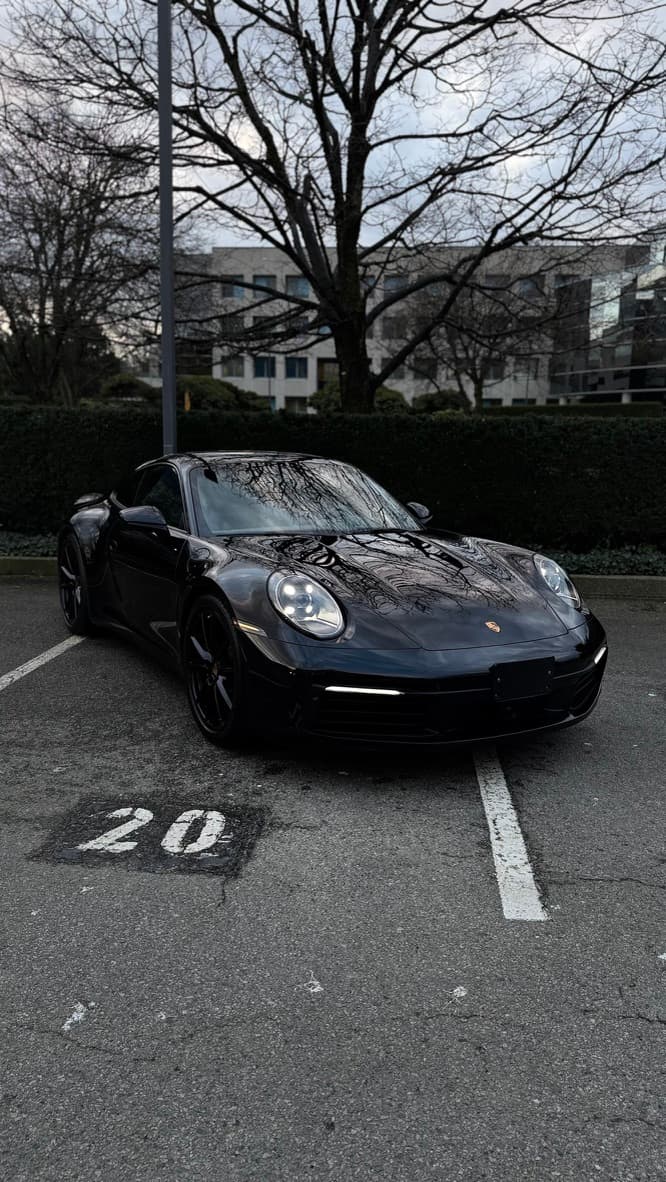
Most of the swirl marks on cars in Maple Ridge are not put there by the road. They're put there by the owner, in December, with a cloth.
That sounds like an insult and it isn't. The reason it happens has nothing to do with being careless and everything to do with the fact that winter changes what's actually sitting on your paint, and nobody adjusts for it.
This post covers why December is the worst month of the year to touch your car, a five-minute check using the one light source that shows swirls best, and the honest answer on when to fix it. Up front: we polish clear coat. We don't repaint panels, and a scratch that catches your fingernail is past anything on this page.
What's Actually Happening
Winter road film is abrasive, and summer road film isn't. Dust and pollen are soft. Road sand and the grit suspended in brine are hard mineral particles. The same wipe that was harmless in July is a sanding block in December.
Cold water doesn't clean properly. Soaps and decontamination chemistry work far better warm. At three degrees, soap barely does its job — so people compensate with more pressure and more scrubbing, which is precisely the wrong correction.
It's dark when you're washing. It's black by half four here through December, so most winter washing happens under a porch light or in a garage. You can't see the grit you're dragging and you can't see the marks you're leaving.
Drying is where most of the damage happens. In summer you can let a car flash off in the sun. In December it won't dry on its own, so everything gets towelled — and a drying towel that's picked up grit is the single most destructive object in car care.
Brush washes are at their worst in winter. Every car going through ahead of you is caked in sand, and those brushes carry it to the next vehicle.
The two-day cycle pushes people toward wiping. The car's filthy again by Wednesday, so nobody wants to do a full wash. They "just give it a quick wipe" instead, which is the most damaging thing available.
The Reason You Notice It in Winter
There's a second effect worth knowing about, and it explains why people think their paint suddenly got worse in February.
Low sun is the best swirl-revealing light there is. Through December and January the sun never gets high — it rakes across your panels at a shallow angle all day, which is exactly the geometry that lights up fine scratches. In July the sun is overhead and the same swirls are nearly invisible.
So part of what's happening is that your paint genuinely is getting worse. And part of it is that winter is the first time all year you can actually see it.
Where It Shows Up
- The hood, roof and trunk lid, because horizontal panels are what people wipe.
- Around the driver's door handle, which gets touched more than any other spot on the car.
- The tailgate or hatch, wiped so you can see the plate or load something.
- Around the fuel door.
- The rear window and the panel below it, wiped so you can see out.
If you compare the hood to the roof, you often learn something. The hood gets wiped constantly and the roof doesn't. A swirled hood above a clean roof isn't road damage — it's hand damage.
A Five-Minute Check
The low winter sun test. Mid-morning or mid-afternoon, park so the low sun rakes across the hood, then look along the panel rather than at it. Swirl marks show as a fine spider-web of circular scratches. This is the single best diagnostic light available and it's free for about three months a year.
The phone flashlight version. In the dark, hold the light nearly flat against the panel and sight across it. Same effect, any time of day.
Compare the hood to the roof. If the hood is marked and the roof isn't, the damage is coming from contact, not from the road.
Check around the door handle and the tailgate specifically. Highest-touch areas on any car.
Look at your drying towel. Properly look at it, under a light. If it's grey or brown, that's what you've been dragging across your paint, and it explains the other four tests.
Test 5 is the one that usually lands. Most people have never inspected the towel.
What You Can Do This Week
Rinse often, touch rarely. This is the whole thing. A touchless rinse once a week does more good than a contact wash once a month, because the salt comes off and nothing abrasive ever meets your paint.
Never wipe a dry panel. Not for a bird dropping, not to see the plate, not for anything. If something has to come off, flood that area with water first.
Only wash above freezing. Water that refreezes in locks, seals and door shuts creates its own problems, and a frozen door seal tears when you pull the handle.
If you're contact washing, use far more water than feels necessary and rinse your mitt constantly. Most winter wash damage is a mitt that picked up grit on panel two and carried it to panels three through twelve.
Use a clean dedicated drying towel and actually wash it. A towel that's been used three times and left in the boot is carrying everything it collected.
Skip the brush washes entirely until spring. Touchless is slower to clean and it won't scratch.
All of that stops new damage. None of it removes what's already in the clear coat — swirl marks are physical scratches, and nothing you wash with takes them out.
When It Needs a Professional
Nothing, if the low-sun test comes back clean. Keep rinsing and don't start wiping. Plenty of cars never need correction.
One-step correction when you can see a fine web across the horizontal panels and the high-touch spots, but nothing catches a fingernail. A single polishing stage removes most of that and brings back the depth the paint had.
Two-step correction when there's heavier swirling, water spotting that won't wash off, or oxidation on older paint. A compounding pass followed by a finishing polish handles what one stage can't.
Past us. Anything that catches a fingernail has gone through the clear coat into the base, and polishing won't remove it. Peeling or flaking clear coat needs respray. Both of those are body shop work, and we'll tell you which you've got rather than sell you a polish that won't fix it.
The Honest Answer on Timing
Here's the part that costs us bookings and is true anyway.
If you correct your paint in December and don't change how you wash it, it'll be swirled again by March. Correction is permanent — the defects are physically removed, not hidden — but nothing stops you putting new ones in next week.
So the order that actually makes sense for most people is: change the washing habits now, correct in spring. You'll spend the money once instead of twice, and the result will still be there in June.
The exception is if you're getting a ceramic coating, because a coating has to go over corrected paint — it bonds to whatever's underneath and locks the swirls in permanently. In that case correction happens whenever the coating happens.
What a Paint Correction Visit Does
We come to you in Maple Ridge — Albion, Silver Valley, Haney, Hammond, Websters Corners. Driveway, carport or garage, and we bring water, equipment and lighting, which matters on a correction because you cannot find defects you can't see.
Full decontamination first, then a paint depth reading to see how much clear coat there is to work with, then stage-appropriate machine polishing, then a panel wipe to reveal the true finish, then a sealant to protect the result.
| What you're seeing | Best fit |
|---|---|
| Low-sun test comes back clean | Nothing — keep rinsing, stop wiping |
| Fine web on the hood, tailgate and door handles | One-step correction — From $600 |
| Heavier swirling, water spots that won't wash off, dull older paint | Two-step correction — From $900 |
| Scratches that catch a fingernail | Not us — that's through the clear coat |
| Clear coat peeling or flaking | Not us — refinisher |
Quick Answers
How much is paint correction in Maple Ridge?
From $600 for a one-step and From $900 for a two-step, both including a six-month sealant. Price depends on vehicle size and paint condition.
Should I stop washing my car in winter?
No — leaving salt on the paint for months is its own problem. Rinse more often and make contact less often. Frequent rinsing is good; frequent touching is what causes swirl marks.
Should I get paint correction now or wait until spring?
Spring, unless you're having a ceramic coating applied. Correcting in December and washing the same way means the swirls will be back by March.
Do touchless car washes scratch paint?
No, which is why they're the right choice in winter. They clean less thoroughly than a careful hand wash, and in December that trade-off is worth making. The car wash vs detailing guide covers the difference properly.
Can paint correction be done in winter?
Yes, with somewhere out of the weather such as a garage or carport. Outdoor work in December is weather-dependent and gets scheduled against the forecast.
Go and look at your drying towel under a light. Then go and look at your hood with the sun low. Those two minutes will tell you more about your paint than anything else you do this month.
Get in touch → We're mobile across Maple Ridge and the rest of Metro Vancouver. Call or text (778) 656-2947.