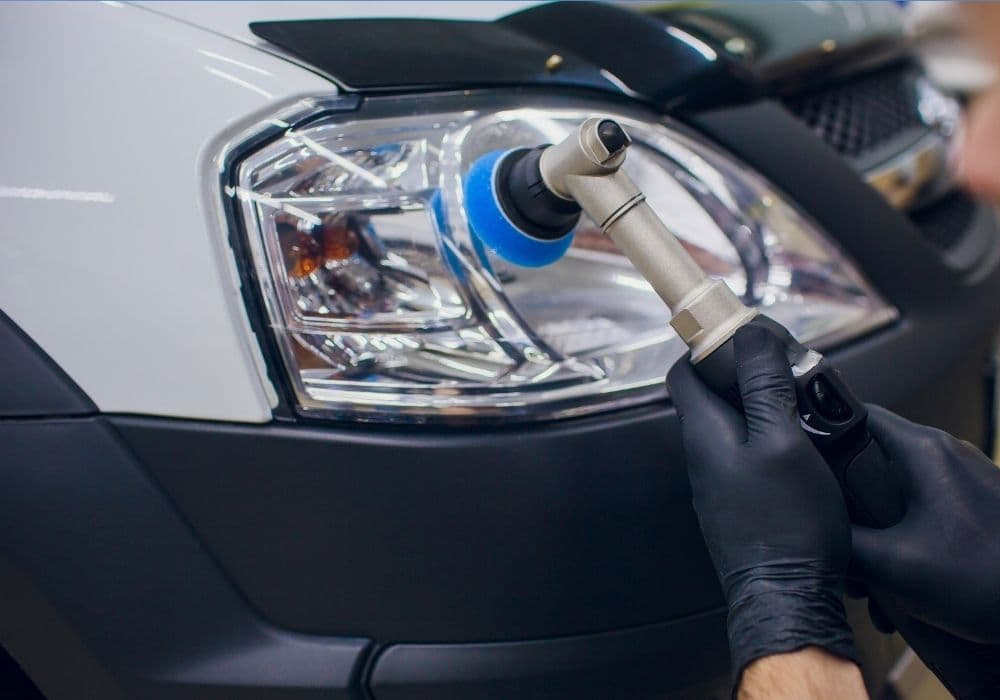
Clocks go back November 1 and your Tri-Cities drive home is suddenly dark. Why headlights haze over, how to test yours, and what restoration costs.
Tomorrow night the clocks go back, and the 5 o'clock drive home from Austin Heights or down the Barnet stops being a daylight drive until February. That's the week most people in Coquitlam, Port Coquitlam and Port Moody notice their headlights aren't doing much. Nothing changed on the car. The light just stopped reaching as far as the dark did.
Walk out to your driveway and look at the lenses in daylight with the lights off. If they look yellow, milky, or like someone breathed on them from the inside, that's not dirt. That's the lens surface breaking down, and it's been getting worse for two or three years without you watching it happen.
This post covers what's actually going on inside a hazy lens, a five-minute test you can run in your own driveway tonight, and the honest split between what a wash fixes, what restoration fixes, and what needs a new housing. One thing up front: we polish and re-coat lenses. We don't replace headlight assemblies, and we don't open them up.
What's actually happening
Your headlights aren't glass. They've been polycarbonate since the mid-90s, which is lighter and far harder to crack — but it yellows badly in sunlight, so the factory sprays a thin UV-resistant hard coat on the outside face.
- That hard coat is the part that fails. It's measured in microns and it's the only thing standing between UV and bare plastic.
- Sunlight breaks it down from above, which is why the top face of the lens always goes first and the bottom edge often still looks fine.
- Highway grit sandblasts it. Lougheed and the Mary Hill Bypass throw a steady stream of sand and road grit at the leading face of the lens all winter.
- Once the coating is gone in patches, UV reaches the polycarbonate itself and the plastic oxidizes — that's the yellow-brown cast.
- Haze doesn't dim your lights evenly. It scatters the beam. You lose the distance down the road and you throw more glare at oncoming traffic at the same time, which is the worst of both.
That last point is the one worth sitting with. A hazed lens doesn't fail quietly. It takes light that was aimed at the road 60 metres ahead and sprays it sideways into the eyes of the car coming the other way on Como Lake Ave.
Where it shows up
- The top third of the lens — most sun hours, first to go. Look down at the lens from standing height, not straight on from the front.
- The outer corners, where the lens wraps toward the fender and the coating was thinnest coming off the line.
- The leading face, with fine pitting you can feel more easily than see — grit damage, not UV.
- Fog lights and tail lights, which almost everyone forgets. Tail lenses are tinted so the yellowing hides better.
- Inside the lens, which is different and matters: a water line, condensation, or a cloudy chrome reflector means the housing seal has failed. No amount of polishing the outside touches that.
A five-minute check
Do this tonight, before the time change. You need a bottle of water and a dark wall.
- Park five metres from your garage door with the low beams on, in the dark. Look at the cutoff — the horizontal line where the light stops. A healthy lens throws a crisp line. A hazed one throws a soft glow with no edge to it.
- Compare left to right. Lenses rarely degrade evenly. One side looking noticeably softer than the other is the clearest signal there is.
- Pour water over the lens and look again while it's still wet. This is the actual diagnostic. Water fills the micro-roughness on the surface and the lens will go temporarily clear if the problem is surface oxidation. If it clears when wet, restoration will work. If it stays hazy soaking wet, the damage is inside the housing and polishing won't help.
- Run a fingernail across the top face. Chalky drag means the hard coat is gone. Slick means it's still there and you're looking at road film, not oxidation.
- Look for a tide line along the bottom inside edge of the lens. That's standing water, and it means a failed seal.
Step 3 is the one that saves people money. We get called out for restorations on lenses that turn out to be fogged from the inside, and we have to tell people at the driveway that we can't fix it. Two minutes with a water bottle tells you first.
What you can do this week
- Wash the lenses deliberately. Most automatic washes brush the paint and skip the lens faces entirely, and road film on top of oxidation looks twice as bad as either alone.
- Keep washer fluid topped up through November. Dry wiping grit across a lens is how pitting starts.
- Park nose-in where you can. A lens facing a garage door or a hedge gets a fraction of the UV hours of one facing open sky off Heritage Mountain.
- Get your aim checked if you've replaced a bulb or had front-end work done. Plenty of "weak headlights" in the Tri-Cities are correctly aimed lenses pointing at the ground.
- Don't try the toothpaste or bug-spray trick. Both abrade the surface, neither replaces the UV coating, and the lens comes back hazier in about two months because you've stripped the last of the hard coat off.
None of this reverses damage that's already there. Clean lenses and good habits slow the next round down — the UV coating that's already gone isn't coming back without sanding and re-coating.
When it needs a professional
A regular wash is enough when the lens is clear underneath and just carrying road film and bug splatter. Wet it, wipe it, and if it looks right, you're done.
It needs restoration. When the lens clears up under running water and goes milky again as it dries, the hard coat has failed and the plastic underneath has oxidized. That's sanding, polishing, and a fresh UV coating — not something that comes off with a cloth.
It's past us. When there's moisture or a water line inside the housing, a crack, a rock chip through the lens, or a reflector that's gone dull and patchy, that's a replacement assembly from a repair shop or dealer. We'll tell you that at the driveway rather than take the money.
What a headlight restoration visit does
We're fully mobile. Headlight restoration is the easiest service in the world to do in a driveway, and it's the one people most often drive across town for — we come to you in Coquitlam, Port Coquitlam and Port Moody instead, driveway or parkade, and we bring water and equipment with us.
The lens gets masked off at the edges, wet-sanded through descending grits to take off the failed hard coat and the oxidized layer under it, machine polished back to clarity, and sealed with a fresh UV coating. Both headlights. About an hour on most vehicles, a little longer on badly pitted lenses.
Which visit matches what you're seeing
| What you're seeing | Best fit |
|---|---|
| Clear lens, just road film or bugs | Wash — exterior detail |
| Lens clears up when wet | Headlight restoration, $140 |
| Haze stays wet, tide line inside | Assembly replacement — body shop |
| Lenses gone and paint has swirls too | Paint correction + restoration |
| Keeping the car and want it to last | Ceramic coating after correction |
Not sure which applies? The driveway check in our wet-leaves post walks through the same water-test logic for paint.
Quick answers
How much is headlight restoration in Coquitlam?
$140 flat for both headlights, at your place. No travel charge inside the Tri-Cities.
Will the haze come back?
Eventually, yes. It's a wear surface. Parking out of direct sun and washing the lenses properly stretches it out a long way.
Can you do it in my building's parkade?
Yes — Klahanie, Suter Brook, Newport Village, Burke Mountain townhouse complexes, all fine. We bring water and equipment and work in the stall.
My paint looks as bad as the lenses. What does that cost?
Different service, and it depends on how deep the damage goes. The paint correction cost guide walks through what drives the number.
Can hazy headlights fail a BC inspection?
Lenses that scatter light badly enough can get flagged. If you've got an inspection booked, ask the facility directly — they're the ones making the call.
How to book
- Call or text (778) 656-2947, or request a quote on the site.
- Tell us the vehicle and whether the lens cleared up during the water test.
- We confirm a time and an address — driveway, office lot, or parkade.
- We show up with water and equipment, and you keep your evening.
Get your light back before the dark sets in
The clocks go back tomorrow and you're driving home in the dark until spring, on whatever light your lenses are still passing. An hour in your driveway fixes it for $140.
Request a quote or call (778) 656-2947.