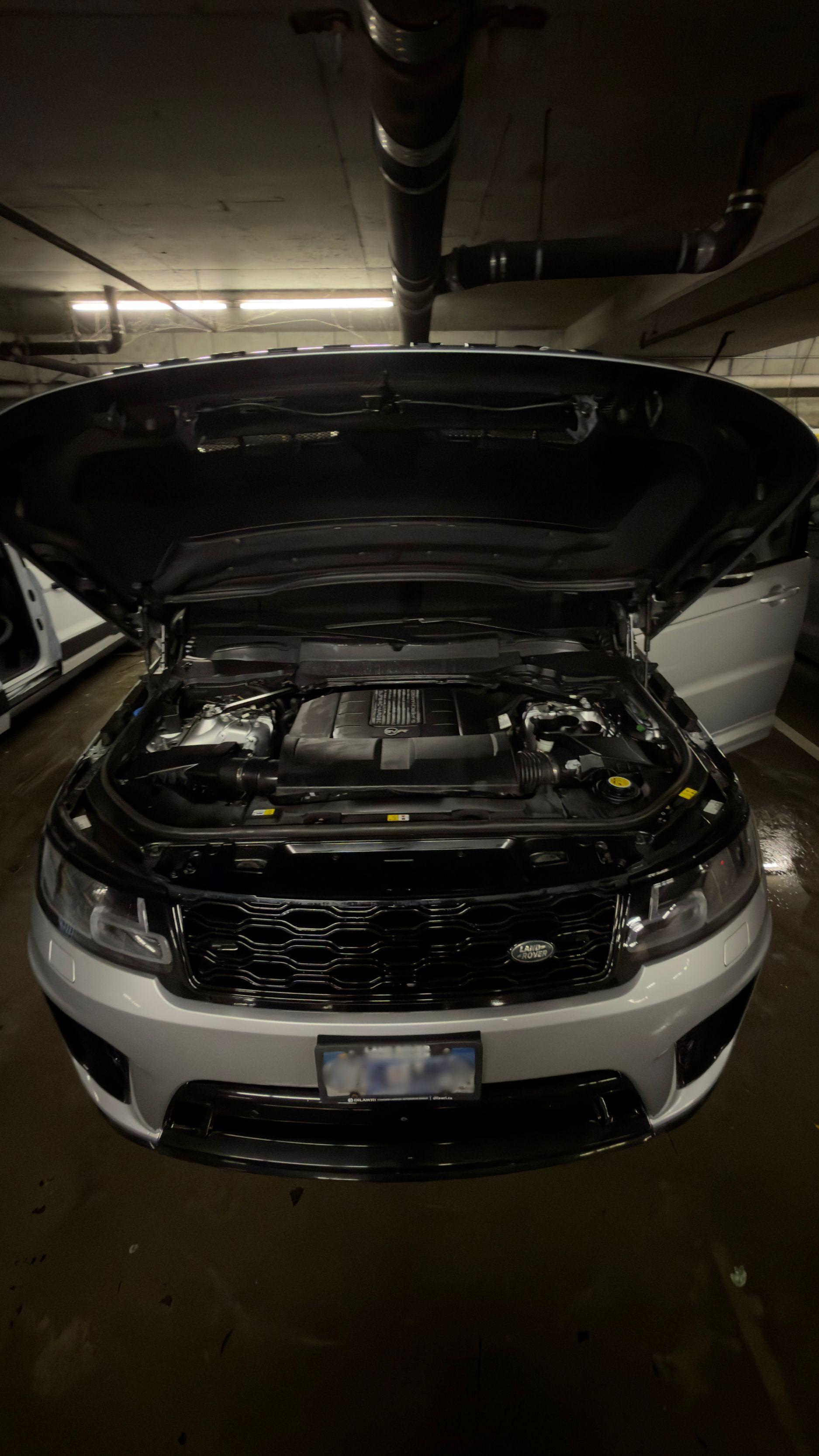
Most people open the hood twice a year, glance at the oil cap and shut it again. That's reasonable for the most part, but there's a specific thing that happens between November and March in the Tri-Cities that's worth understanding, because it causes problems that get blamed on something else entirely.
Spend twenty minutes behind a truck on the Barnet or coming across the Pitt River Bridge in the wet and you take a steady stream of road spray. Bridge decks get treated first and treated heaviest, so a lot of what's being thrown at you is salt in solution rather than plain water, and it does not stay on the outside of the car.
This post covers how brine gets into a sealed-looking engine bay, the damage it actually causes, and a check you can do yourself with the engine cold. One thing plainly first: we clean engine bays. We do not diagnose electrical faults, fix leaks or replace anything, and if your car already has a problem, cleaning the bay is not the fix.
What's Actually Happening
Brine arrives as mist, not splash. Liquid anti-icing gets atomized by the tyres in front of you into a fine aerosol that follows the airflow through the grille and up from under the car. Because it's mist rather than droplets, it coats the tops and undersides of components equally, including surfaces that plain water would never reach.
The engine bay is not sealed. Air comes in the grille, past the rad support and up through the undertray gaps by design, because the engine needs airflow. Everything carried in that air gets deposited inside the bay.
Salt is conductive once it's damp, and it pulls moisture in on its own. That is the real problem, and it lands on rubber-sealed electrical connectors that may be a decade old.
Engine heat bakes it on. The area around the manifold and the turbo runs well over 100°C. Salt-laden grime that settles there dries into a hard crust that a hose will not shift, which is why a quick rinse cleans the pretty parts and leaves the worst of it.
Oily grime holds the salt against the metal. Dirt by itself doesn't corrode anything. Dirt that holds a brine solution in contact with aluminium and steel for five months does, because it never gets a chance to dry out.
The Part Worth Knowing About
The headline damage from salt in an engine bay is not rust, and it's not cosmetic.
It's intermittent electrical faults. Salt works past a tired connector seal, draws moisture in, and corrodes the pins. You get green or white crust on copper, resistance where there shouldn't be any, and a signal that drops out when it's damp and comes back when it's dry. In practice that presents as a check engine light that appears and disappears, an ABS or traction light that only shows up in the rain, or a sensor reading that goes erratic for a week. Those are genuinely difficult to chase down, and a surprising number of them start as salt in a plug.
Ground straps are the other one. The braided or flat straps that bond the engine to the body are bolted to painted metal, and salt attacks the contact face. A degraded ground produces symptoms that look unrelated to each other — dim or flickering lights, gauges behaving oddly, hard starting — and almost nobody traces that back to a corroded strap end.
Aluminium corrodes differently from steel. Modern bays are full of it, and salt makes aluminium go chalky white rather than flaky orange. It doesn't fall away like rust does, it swells, and on a bolted joint it seizes the fastener solid. Anyone who's tried to undo a ten-year-old bracket bolt on a car that's lived its whole life in the Lower Mainland has met this.
Where It Shows Up
- The front of the bay — the rad support, slam panel and everything directly behind the grille, which takes the first hit.
- The battery tray and terminals, which is the classic spot, and the tray itself is often painted steel that rusts through from underneath.
- Low-mounted connectors near the front of the bay and down by the headlights.
- Ground strap ends, at both the engine and body bolts.
- Aluminium brackets, bolt heads and strut towers.
- The cowl at the base of the windshield, where drain channels fill with fir needles and leaves, then hold water against metal all winter.
A Five-Minute Check
Engine off and cold before you touch anything. Don't pull connectors apart to inspect them — that's how a seal that was doing its job stops doing it. Look only.
Look at the battery terminals and the tray underneath. Blue-green crust on a terminal or a tray that's gone brown and soft at the edges is the clearest signal in the bay.
Run a finger along the painted front rad support, then look at your finger. Grit and a grey film means road spray has been landing there since October.
Look for white powder on anything aluminium — brackets, the intake, the top of a strut tower. That's salt-driven corrosion and it tells you how much is getting in.
Find the main ground strap from the engine to the body and look at both bolted ends. Green or white buildup there is why ground-related faults get blamed on random sensors.
Clear the cowl drains at the base of the windshield. Lift the wiper arms, look along the channel, and pull out the needles and leaf mush by hand. This one takes two minutes, costs nothing, and a blocked cowl drain is how water ends up somewhere it has no business being.
Number five is the one to do tonight regardless of anything else in this post. It takes two minutes, costs nothing, and a blocked cowl drain is how water ends up somewhere it has no business being.
What You Can Do This Week
Clear the cowl and the area in front of the rad support of leaves and needles. Zero risk and genuinely worthwhile in a Tri-Cities November.
Wipe the reachable painted surfaces with a damp microfibre. The slam panel, the strut tower tops, the inner fender lips. You're removing salt, not polishing.
Clean the battery terminals if there's buildup. Put a corrosion inhibitor on them afterwards if you're comfortable doing it.
Resist the pressure washer. Forcing water into connectors, the alternator and the fuse box is how a cosmetic job turns into a repair bill, and this is the single most common way people damage their own car trying to clean the bay.
What that gets you is the roughly thirty percent of the bay you can actually reach. It does nothing about salt sitting in connectors, nothing about the baked-on crust near the hot components, and nothing about what's collected on the undersides of things where you can't get a cloth.
When It Needs a Professional
Nothing needs doing at all. If the car is newer, the bay still looks close to factory and there's no white powder or terminal crust, clear the cowl drains and shut the hood. Don't pay anyone.
It's worth an engine bay cleaning. When there's a visible salt and grime film across the bay, when the battery tray area is building up, when you're selling the car, or when you want to be able to spot a new leak. That last one is underrated — on a clean bay a weeping hose or a seeping gasket shows up as a fresh wet patch within days, and on a filthy bay you find out when it fails.
It's past us. An electrical fault that's already happening needs a mechanic with a scan tool, not a detailer. An active oil or coolant leak needs fixing before cleaning is worth paying for. A battery tray that's rusted through, and fasteners already seized by corrosion, are repair work.
What an Engine Bay Cleaning Does
We come to you across the Tri-Cities — Coquitlam, Port Coquitlam and Port Moody. Driveway, office lot or building parkade, and we bring water, equipment and lighting, which matters when the job involves looking closely into a dark space in November.
The work is controlled water, sensitive components protected, degreaser worked in by hand on the surfaces that need it, and the bay dried and dressed afterwards. It is not a pressure wash, and the difference between those two approaches is most of the reason to have someone else do it.
| What you're seeing | Best fit |
|---|---|
| Newer car, bay looks close to factory | Clear the cowl drains and leave it |
| Grey salt film and grime across the bay | Engine bay cleaning — From $100 |
| Battery terminal crust and a grimy tray | Engine bay cleaning — From $100 |
| Selling the car and the buyer will open the hood | Engine bay cleaning — From $100 |
| Check engine or ABS light that comes and goes | Not us — a mechanic with a scan tool |
| Active oil or coolant leak | Not us — fix it first, then clean |
| Battery tray rusted through, seized fasteners | Not us — repair work |
Quick Answers
Is cleaning a car engine bay safe?
Done properly, yes. Done with a pressure washer and no thought about where the water goes, no. The job is about controlling water and protecting the components that shouldn't get wet.
Will cleaning the engine bay fix a check engine light?
No. Cleaning removes salt so corrosion stops getting worse. A fault that already exists needs diagnosing by a mechanic with a scan tool.
How often should an engine bay be cleaned?
Once a year is plenty for most cars in Metro Vancouver, and the end of winter is the sensible time — after the road salt has stopped and before it sits there all summer.
Does a clean engine bay help when selling a car?
More than it arguably should. Many buyers open the hood without being able to interpret much of what they see, and a tidy bay reads as a maintained car.
Can an engine bay be cleaned in winter?
Yes. A dry window and some shelter make for a better job, but it doesn't need to wait for spring. Salt sitting in the bay now means five more months in contact with metal.
How to Book
- Call or text (778) 656-2947, or send a message through the contact page.
- Tell us the vehicle and roughly what the bay looks like, or send a photo with the hood up.
- We confirm a time and a price.
- We come to you in Coquitlam, Port Coquitlam or Port Moody.
Related: the same brine coating your lower doors on the Mary Hill Bypass is the brine getting into your engine bay. If you spend any time on that corridor, the road salt on Mary Hill Bypass piece covers what to check on the outside of the car.
Open the hood tonight, lift the wipers and pull the needles out of the channel at the base of the windshield. It takes two minutes and it's the highest-value thing in this entire post.
Get in touch → We're mobile across Coquitlam and the rest of the Tri-Cities, and engine bay cleaning can be added to any detail. Call or text (778) 656-2947.