Ceramic coating cost in Vancouver runs about $500–$900 for an entry-level 1–2 year coating, $900–$1,600 for a 3–5 year coating, and $1,500–$2,500+ for a 5–10 year or lifetime-warranty coating (2026 Metro Vancouver market range). Multi-layer and top-tier applications run $2,500–$4,000+. The largest single variable isn't the coating itself — it's how much paint correction the car needs first, which accounts for most of the labour on any coating job.
| Coating tier | Rated durability | Typical time | Metro Vancouver market range |
|---|---|---|---|
| Entry-level | 1–2 years | 1 day | $500–$900 CAD |
| Mid-tier | 3–5 years | 1–2 days | $900–$1,600 CAD |
| Premium | 5–10 years | 2 days | $1,500–$2,500+ CAD |
| Top-tier / multi-layer | Lifetime warranty | 2–3 days | $2,500–$4,000+ CAD |
All prices in CAD and include a standard single-stage correction on most quotes. Metro Vancouver market range reflects vehicle size, paint condition and coverage. Prices checked November 2026.
Ceramic Coating Prices in Vancouver by Tier
The market segments coatings by rated durability, and durability tracks fairly closely with film thickness, hardness and the chemistry of the product. What you're paying for at the top of the range is a thicker, harder, longer-warrantied layer — and, usually, more preparation underneath it.
Entry-Level Coating (1–2 Year): $500–$900
Metro Vancouver market range for an entry-level ceramic coating is $500–$900 CAD (2026). These are consumer-grade or short-duration professional products, applied in a single day, usually over a light polish or a decontamination-only prep.
They give you real hydrophobic behaviour and easier washing, and they're a reasonable choice on a lease vehicle, a second car, or paint you don't intend to keep for long. What they don't give you is a manufacturer-registered warranty, and the shorter the rated life, the sooner you're paying again.
Mid-Tier Coating (3–5 Year): $900–$1,600
Metro Vancouver market range for a mid-tier coating is $900–$1,600 CAD (2026). This is the volume segment of the market and where most daily drivers land.
A quote in this range typically includes a one-step correction, full chemical and mechanical decontamination, and a registered coating with a warranty that requires documented maintenance. The spread inside the range is almost entirely correction and vehicle size — a well-kept sedan sits near the bottom, a swirled SUV near the top for the identical coating product.
Premium Coating (5–10 Year): $1,500–$2,500+
Metro Vancouver market range for a premium coating is $1,500–$2,500+ CAD (2026). These are the thicker, harder professional coatings with longer manufacturer warranties, and they're almost always quoted with a two-step correction because applying a ten-year product over defects you'll be looking at for ten years makes no sense.
This tier is the right choice if you're keeping the vehicle long term, if it's a newer car you want protected from the start, or if resale value is part of the reasoning.
Top-Tier and Multi-Layer: $2,500–$4,000+
Metro Vancouver market range for top-tier work starts around $2,500 and reaches $4,000+ CAD (2026). This covers multi-layer systems, two-component coatings that cross-link as they cure, and lifetime-warranty products, usually combined with multi-stage correction and extended coverage across wheels, glass and trim.
Most people don't need this. It exists for owners who want maximum hardness and chemical resistance on a vehicle they care about more than the average driver cares about theirs.
Ceramic Coating Cost by Vehicle Size
An SUV or truck typically costs $200–$500 more than a sedan for the same coating tier. More panels means more correction hours and more coating to apply, and the gap widens at the higher tiers because the correction underneath scales with surface area.
| Tier | Sedan / coupe | SUV / crossover | Truck / van |
|---|---|---|---|
| Entry-level | $500–$750 | $650–$900 | $650–$900 |
| Mid-tier | $900–$1,300 | $1,100–$1,600 | $1,100–$1,600 |
| Premium | $1,500–$2,000 | $1,800–$2,500+ | $1,800–$2,500+ |
| Top-tier / multi-layer | $2,500–$3,200 | $2,800–$4,000+ | $2,800–$4,000+ |
Metro Vancouver market range, 2026. Paint condition affects the total more than vehicle category on most jobs — a badly swirled coupe can cost more than a well-kept SUV.
What Changes the Price of a Ceramic Coating?
Correction matters most, then coverage, then coating tier, then vehicle size. That order surprises people who assume the product is the expensive part.
Paint correction
This is the one that moves a quote by four figures. The coating itself is a few hundred dollars of material and a few hours of careful application. The correction underneath it can be anywhere from one hour of light polishing to two days of multi-stage work.
A coating bonds permanently to whatever finish is under it. It does not hide swirl marks — it seals them in, and the added gloss and clarity often make them more visible, not less. So the question before a coating appointment is never whether to correct, only how much. Our paint correction cost guide breaks down what each stage costs and how to tell which one your paint needs.
Coverage
Paint-only is the baseline. Most shops price wheels, glass, trim and interior surfaces as add-ons, and each is genuinely more work rather than a markup:
- Wheels — ideally removed to coat the barrels properly
- Glass — a separate product with a different application process
- Trim and plastics — dressing is temporary, coating is not
- Leather and interior — a different chemistry entirely — see leather coating
A paint-only quote and a full-coverage quote on the same car and the same tier can differ by $400–$800.
Coating tier and warranty registration
Manufacturer-backed warranties require a certified installer and a registered application, and the registration itself carries a cost that gets passed through. That's also what makes the warranty real rather than a verbal promise — an unregistered coating has no warranty regardless of what you were told.
Ask whether a coating is registered in your name and what the maintenance conditions are. Nearly every warranty requires documented maintenance washes at set intervals, and failing to do them voids it.
Number of layers
A second layer isn't twice the protection, but it does add film thickness, and on some products the manufacturer requires it to activate the longer warranty. Expect $200–$500 for an additional layer depending on tier.
Vehicle size
More panels, more glass, more trim to mask. Coating a full-size van takes substantially longer than a coupe at every stage of the process.
Mobile vs shop
Mobile coating costs broadly the same as shop coating in Metro Vancouver — overhead and logistics roughly offset. The practical difference is that a shop gives you a controlled environment and a mobile installer means the car never drives anywhere on a freshly applied coating, which matters more than most people expect during the cure window. We've written the honest comparison in mobile vs shop ceramic coating.
What's Included in a Ceramic Coating (and What Isn't)
A proper coating application follows a fixed sequence. A quote well below market range almost always means one of these steps was skipped, and the steps that get skipped are the ones you can't see afterwards.
- Hand wash. A thorough contact wash with clean microfiber before any other work begins.
- Iron and tar decontamination. Chemical fallout remover dissolves the embedded iron particles that washing cannot lift, and tar solvent handles road tar.
- Mechanical decontamination. Clay or a clay substitute removes bonded particles so the polisher is working on genuinely clean paint.
- Paint depth gauge reading. Measures the available clear coat before any cutting begins.
- Correction. Stage-appropriate machine polishing — this is where most of the hours go.
- Panel wipe. An IPA or dedicated prep solution strips polishing oils and residue. Skipping this is the single most common cause of a coating failing early, because the coating bonds to the residue instead of the clear coat.
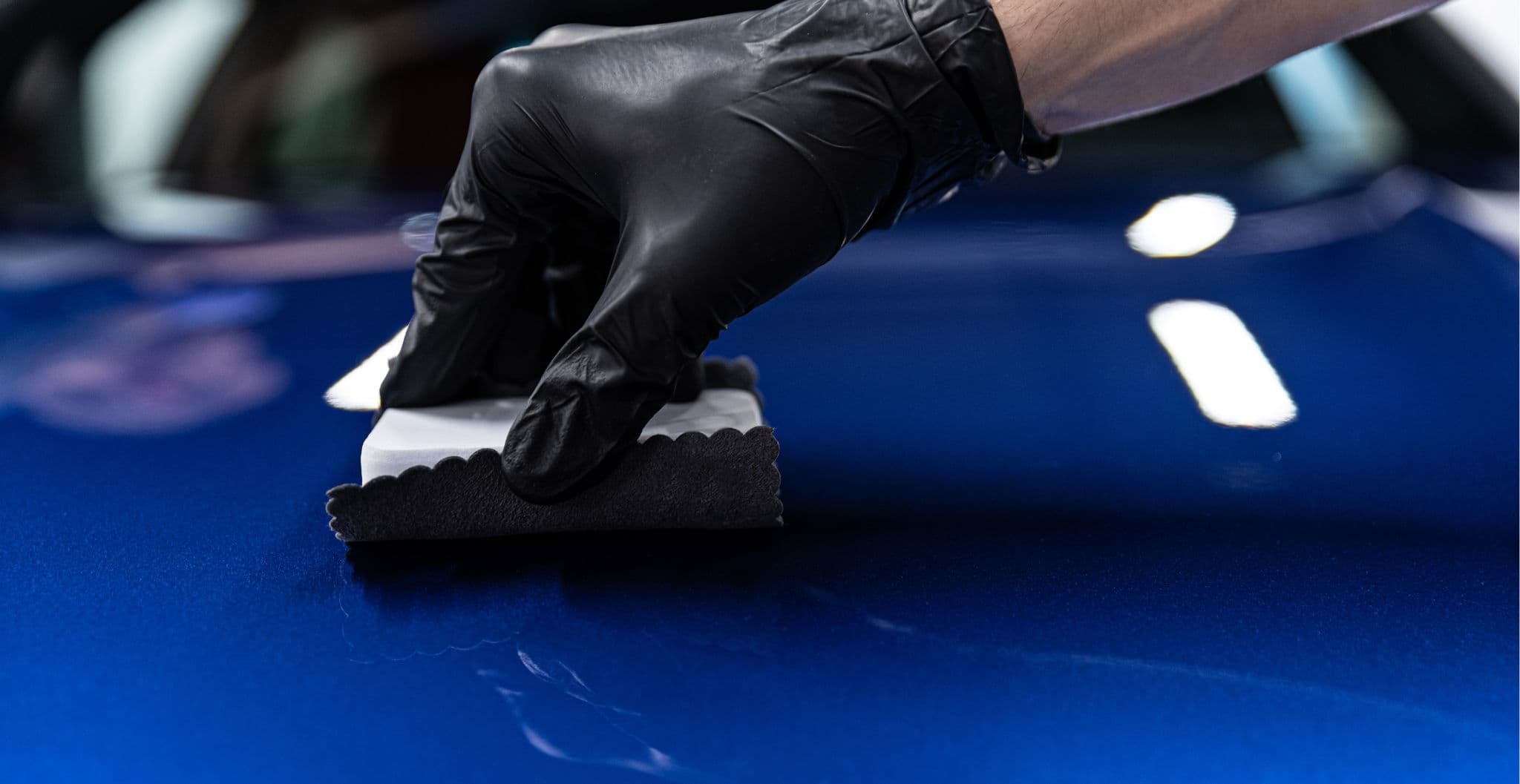
- Coating application. Applied and levelled by hand, panel by panel, within a working window measured in minutes per section.
- Cure time. The coating needs to stay dry and undisturbed while it sets, typically 12–24 hours before exposure to water and longer to reach full hardness.
- Inspection under direct lighting. Every panel checked for high spots — coating that wasn't levelled properly and has cured as a visible streak.
- Aftercare instructions. What to wash it with, when, and what will void the warranty.
What a ceramic coating can't do
It doesn't stop rock chips. Hardness ratings measure scratch resistance at a microscopic level, not impact resistance. A stone off the Lougheed will chip coated paint exactly as it chips uncoated paint. Paint protection film is the product for that, and it does a completely different job.
It doesn't make paint scratch-proof. It raises the threshold. An automatic brush wash will still mar a coated car.
It doesn't hide existing defects. It locks them in for the life of the coating.
It doesn't eliminate washing. It makes washing far more effective, which is a different claim. Contamination still lands on the car; it just releases more easily.
It doesn't fully prevent water spotting. Hard water minerals left to dry on a coated surface can still etch the coating itself. In Metro Vancouver's climate this is the most common real-world failure mode.
Ceramic Coating vs Paint Protection Film: Which Costs More?
These get compared constantly and they aren't substitutes.
A ceramic coating is a chemical layer measured in microns that provides gloss, hydrophobic behaviour and chemical resistance across the whole vehicle. Metro Vancouver pricing runs $500–$2,500+.
Paint protection film is a physical urethane layer measured in thousandths of an inch that absorbs impact. Partial-front coverage runs roughly $1,200–$2,500 and full-vehicle coverage $4,000–$8,000+ in this market.
Plenty of people do both: film on the impact zones, coating over the top and across the rest of the car. If your main concern is rock chips on the highway, film is the answer and a coating alone will disappoint you. If your concern is gloss, easier washing and chemical resistance, a coating is the answer and film is an expensive way to get there.
Is Ceramic Coating Worth It?
Yes, if you're keeping the car 3+ years, hand washing it, and the paint is in correctable condition. Probably not if none of those apply.
Worth it
- ·New vehicle you plan to keep
- ·Keeping the car 3+ more years
- ·Black or dark paint
- ·Parked outdoors year-round
- ·You hand wash or use touchless
- ·Resale value matters to you
- ·Car lives under trees or in a parkade
Probably not
- ·Lease ending within a year
- ·Clear coat already failing or peeling
- ·Car goes through brush washes weekly
- ·Won't do the maintenance washes a warranty requires
- ·Vehicle is being sold imminently
- ·Budget doesn't cover the correction it needs
That last one is worth sitting with. A coating applied over uncorrected paint on a tight budget is the worst outcome available — you've paid for protection and permanently sealed in every defect. A one-step correction with a six-month sealant costs less and leaves you better off.
How Long Does a Ceramic Coating Actually Last?
Rated durability and real-world durability are different numbers, and any shop that tells you otherwise is selling.
A coating's rating reflects laboratory testing and manufacturer specification. What you actually get depends on how the car is washed, where it's parked, how much highway salt it sees and whether the maintenance schedule is followed. A nine-year-rated coating on a car run through brush washes every fortnight will not perform like a nine-year coating.
The warranty length is the more useful number, because it's a contractual commitment rather than a performance estimate — and it comes with conditions. Read them. Most require documented maintenance washes at set intervals through a certified installer.
What degrades a coating fastest in this climate: hard water left to dry on the surface, brush washes, acidic contamination such as bird droppings and sap left on the paint, and aggressive alkaline cleaners.
Why Vancouver Cars Benefit More From Coating
Metro Vancouver's conditions attack paint in a specific combination that makes a coating more useful here than in a dry climate.
Winter brine from November through March is applied as a liquid and stays wet, because salt holds moisture out of the air. A coated surface releases that film with a rinse; bare clear coat holds it.
Rain volume means cars spend months wet, and anything acidic that lands on the paint sits in solution against it. Maple Ridge and the eastern valley get measurably more precipitation than downtown.
Tree sap and pollen from April through June across the North Shore, Burnaby Mountain, Burke Mountain and Maple Ridge, all of which sit under heavy cedar and fir canopy. Sap bonds fast in warm weather and etches clear coat if left.
Hard water in parts of the region leaves mineral deposits that etch as they dry — which is also the main thing that damages coatings, so the maintenance advice matters more here than the marketing does.
Parkade concrete dust and brake dust settle on cars parked underground and get wiped dry, which is how most swirl marks in this city are actually created.
For a vehicle kept outdoors here for three to five years, the question is less whether protection is worth it and more which level makes sense for how long you're keeping it.
Ceramic Coating Cost FAQ
What does a ceramic coating usually cost?
In Metro Vancouver, ceramic coating costs roughly $500–$900 for an entry-level 1–2 year coating, $900–$1,600 for a 3–5 year coating, and $1,500–$2,500+ for a 5–10 year or lifetime-warranty coating (2026 market range). Multi-layer and top-tier applications run $2,500–$4,000+. The biggest variable is how much paint correction the vehicle needs first.
Why do ceramic coating quotes vary so much?
Because most of the quote is correction, not coating. The product and its application are a relatively fixed cost. The polishing underneath ranges from one hour to two days depending on paint condition, and that's what separates a $900 quote from a $2,200 one on the same vehicle.
Do I need paint correction before a ceramic coating?
Yes, in some amount. A coating bonds permanently to the finish beneath it and makes defects more visible rather than less. The only question is which stage your paint needs, which the paint correction cost guide covers in detail.
Is ceramic coating worth it on an older car?
It depends on the clear coat, not the age. If the clear coat is sound and the defects are correctable, a coating works fine on a ten-year-old car. If the clear coat is thin, failing or peeling, no coating will help and applying one wastes the money.
How long does a ceramic coating last?
Rated durability runs from one or two years at entry level to lifetime warranty at the top tier. Real-world performance depends on washing method, parking and maintenance. Hard water and brush washes shorten the life of any coating.
Does a ceramic coating prevent scratches and rock chips?
No. It raises the threshold for light marring but it does not stop impact damage. Paint protection film is the product for rock chips, at roughly $1,200–$2,500 for partial front coverage in this market.
Can a ceramic coating be applied in winter in Vancouver?
Yes. It needs a dry window and somewhere the car can sit undisturbed while it cures, which is a scheduling question rather than a seasonal impossibility. Coatings are often applied in late autumn to get protection on before brine season.
Is a cheap ceramic coating better than no coating?
Usually not, if it means skipping the correction. A coating over uncorrected paint seals in every defect for the life of the product. A one-step correction with a six-month sealant costs less and leaves the car in a better position.
What's the difference between ceramic coating, wax and sealant?
Durability and chemistry. Wax lasts weeks, a sealant lasts months, a coating lasts years. The ceramic coating vs wax vs sealant guide compares them properly.
Ready to protect your paint properly? Get in touch →
For full Metro Vancouver detailing prices across every service, see the car detailing cost in Vancouver guide. For the full breakdown of what paint correction costs by stage and how to read which stage your paint needs, see the paint correction cost guide.