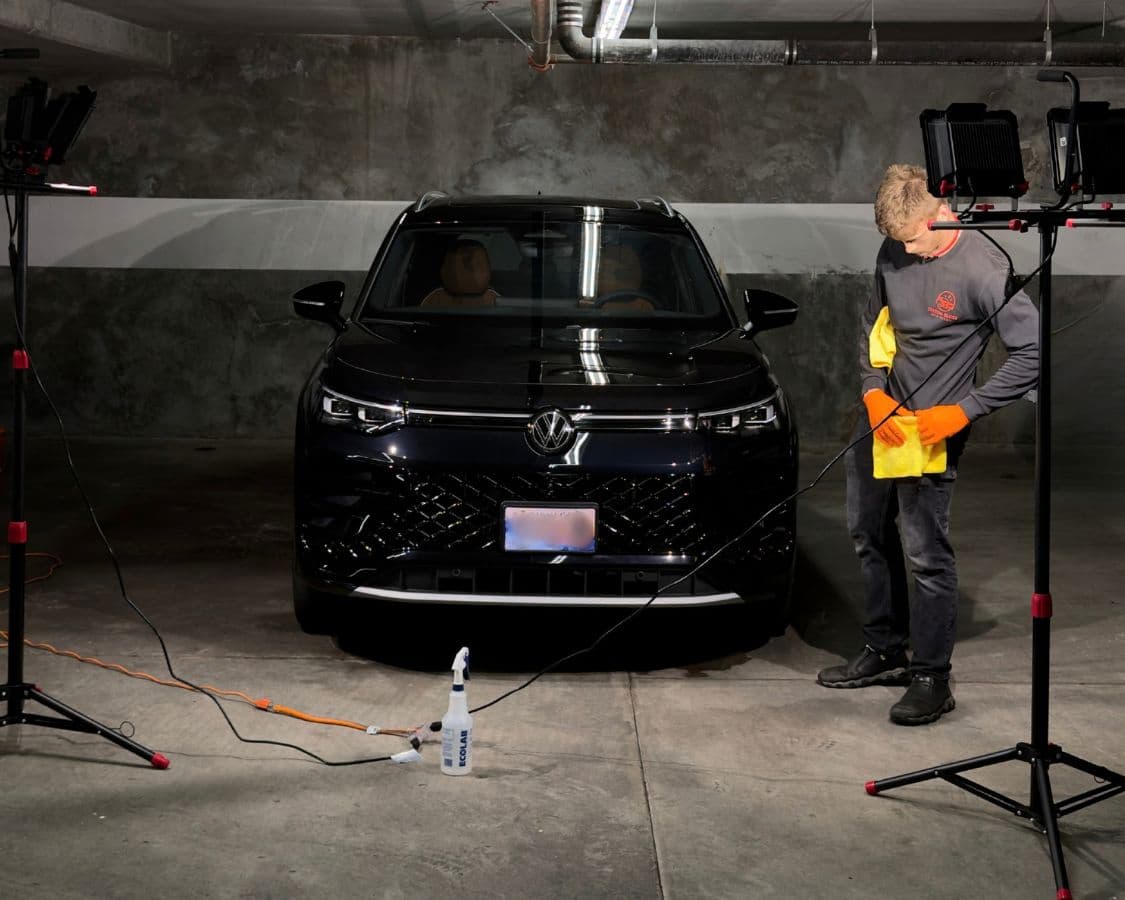
People ask whether we can coat a car in their building's parkade in a slightly apologetic way, as though they're asking for a favour or a compromise. It isn't either. Between November and March in Port Moody, an underground stall is the best place to apply a ceramic coating, and it's better than most driveways by a wide margin.
The reason is simple and it has nothing to do with convenience. A coating has to cure without getting wet, and it goes on better at a stable temperature. A parkade gives you both of those things for free, and a Port Moody driveway in late November gives you neither.
This post covers why coating has physical requirements that a wash doesn't, exactly what we need from your stall, and what actually goes wrong when a parkade job goes sideways. Said plainly first: a coating preserves whatever condition the paint is in when we apply it. It does not improve paint, and we don't do bodywork or repaint panels.
Why a Coating Has Requirements a Wash Doesn't
It has to cure without water contact. Rain, overnight dew and a neighbour's sprinkler are all the same problem. This is the single hardest thing to arrange outdoors in a Lower Mainland winter and the single easiest thing about a parkade.
Temperature affects how the product goes on. Coatings have a working range, and a cold panel changes how the product levels and flashes. A parkade holds somewhere around eight to fourteen degrees through the winter, which is both warmer and far steadier than the air outside.
A curing coating is tacky, and whatever lands in it stays in it. Outdoors in Port Moody that means fir needles, leaf fragments and whatever the wind brings off the inlet. Nothing falls from above in a parkade, which is a real advantage even though parkade air carries its own brake and concrete dust at floor level.
Panel temperature matters more than air temperature. A car driven in and parked has a warm hood and cold doors, which is not a good surface to coat. It wants to sit and even out first.
Finding paint defects requires the right light, and parkade lighting is the wrong light. Flat overhead fluorescents hide swirl marks almost perfectly. We bring our own lighting for this reason, because you cannot correct what you cannot see.
What We Need From Your Stall
This is the honest list, in order of how often each one causes a problem.
Room to work around the car, not just a stall it fits in. We need to get to every panel with both arms. In practice that means an end stall, a stall next to an empty one, or your second stall if you have two. A car wedged between two parked vehicles cannot be coated properly, and that's the thing that most often turns into a reschedule.
Ceiling clearance over the stall. Plenty of parkades run ducts, sprinkler mains and beams low over particular stalls. We're working above the roof of the car for part of the job, so a pipe directly overhead matters.
Access in and out. Either someone lets us through the gate at the start and end, or we need a fob for the duration. This sounds trivial and it is the thing most likely to cost an hour.
A heads up to your strata or property manager. Many buildings have rules about work in the parkade, and some specifically prohibit vehicle washing down there. It's much better to know that before we arrive than after.
An outlet somewhere nearby, if there is one. Our lighting is better when we can plug in. It isn't a dealbreaker, but it's worth telling us either way so we plan for it.
The Water Question, Which Nobody Brings Up
Worth being straight about this, because it's the one genuine complication with a parkade coating.
A coating job starts with a decontamination wash, and that stage uses water. A lot of buildings allow it and have floor drains for exactly that purpose. Some buildings prohibit washing vehicles in the parkade outright, and a few have signage about it that residents have stopped noticing.
If yours is the second kind, it doesn't kill the job. The wash stage happens elsewhere and the correction and coating happen in your stall, which is where they benefit most from being indoors anyway. But we need to know which situation we're in when we book, not when we're standing in it.
Why Mobile Beats a Shop for Cure Time
Shop-based installers coat the car at their place, which means the vehicle stays with them for the cure — a day or more without it. A parkade coating cures in the stall the car was going to be parked in anyway. For ceramic coating specifically, cure time is the one thing that makes location a real cost to you, and doing the job where the car already lives removes that cost completely.
A Five-Minute Check of Your Stall
Go down and do this. It takes less time than reading about it, and it answers most of the questions above.
Park normally, then open both doors fully and see whether you can walk all the way around the car without turning sideways. That's the access test and it's the one that matters most.
Stand beside the car and reach straight up. Note anything within arm's reach of the roofline — a duct, a sprinkler pipe, a low beam.
Find the nearest outlet and see roughly how far it is from the stall, and whether it looks live. Our work lighting runs off it when it's available.
Look for a floor drain, and look for signage about washing vehicles. Both tell you something about whether the decontamination wash can happen in your stall or needs to happen somewhere else.
Check whether your stall sits in a drive aisle people need to get through. A stall at the end of a row is easy. A stall halfway along a single-lane aisle means we're in everyone's way for several hours.
Test 1 is the one that decides whether this works. If you can't walk around the car with the doors open, send us a photo before you book and we'll sort out a better spot.
What You Can Do Before We Arrive
Tell the strata or property manager, briefly and in advance. One email is usually the whole process.
Clear the stall of bikes, bins and storage, and the adjacent one too if it's yours. Everything we need to reach around the car has to actually be reachable.
Park it the night before rather than driving it in that morning. Dry paint and even panel temperatures both make for a better result.
Sort the gate access, either by being home or leaving a fob. This is the single most common cause of a delayed start.
Plan for the car to stay parked after we finish. The coating cures where it sits, which in a parkade is no inconvenience at all, but it does mean not driving it straight out into the rain.
None of that changes whether the stall physically has room, which is the one thing you can't prepare your way around. Check that first.
When a Parkade Works and When It Doesn't
A parkade is the right venue. Adequate access around the car, no low obstruction, strata is fine with it, and you can leave the car parked afterwards. That's most buildings, and in winter it produces a better result than a driveway.
We need a different spot. No room to work either side, a duct directly over the stall, a vehicle too tall for the clearance, or a strata that won't allow it. In those cases we'll look at a visitor stall, the surface lot, or your workplace parking instead — we're fully mobile, so the parkade is a preference rather than a requirement.
It's past us. Failing or peeling clear coat, deep scratches through to primer, and dents and rust are not things a coating addresses. A coating locks in the condition underneath it, so anything that needs fixing needs fixing first. Where the paint needs correcting before coating, that's paint correction and it's quoted separately.
What a System X® Ceramic Coating Visit Does
We come to you across Port Moody — Suter Brook, Klahanie, Newport Village, Moody Centre and the buildings around Inlet Centre and Heritage Mountain. Parkade, driveway or office lot, and we bring water, equipment and lighting.
The job is a decontamination wash, paint correction where it's needed, then the System X® coating applied panel by panel and levelled. It's a full day's work for most vehicles, and the car stays where it is afterwards while the coating cures.
| What you're seeing | Best fit |
|---|---|
| End stall or empty neighbour, strata fine with it | System X® coating in your parkade — From $1,119 |
| Tight stall between two parked cars | Send a photo first — we'll find a better spot |
| Low duct or sprinkler main over the stall | Surface lot, visitor stall or driveway instead |
| Swirled or dull paint you want coated over | Paint correction first, quoted separately |
| Peeling or failing clear coat | Not us — a coating won't fix it |
| Dents, rust, cracked glass | Not us — body shop or glass shop |
Quick Answers
How much is a ceramic coating in Port Moody?
From $1,119 for System X® Crystal+, with Pro+, Max G+ and Phantom above it. Our ceramic coating cost guide breaks down what moves the price.
How long does the car need to stay parked after a ceramic coating?
The coating is tack-free within a few hours. We recommend leaving the car parked in the stall where we applied it for a full 24 hours so the first cure stage completes without exposure to rain or wash water. Full cure continues over the following seven days — no automatic washes during that window. We confirm the exact guidance for the tier we're installing before we start.
Is a parkade really as good as a shop for ceramic coating?
For the coating and cure stages in a Lower Mainland winter, it's genuinely close. You get shelter, stable temperature and no rain, which are the three things that matter. What a shop has that a parkade doesn't is better light for paint correction, which is why we bring our own work lighting.
Do I need to be there the whole time?
No. We need access at the start and the end. Most parkade jobs run with the owner upstairs for the day.
Can you coat a car in the rain?
We can work in it — we're out through Metro Vancouver winters. But a coating specifically needs to cure dry, which is exactly why doing it in your parkade in November makes more sense than doing it on your driveway.
How to Book
- Call or text (778) 656-2947, or send a message through the contact page.
- Do the five-minute stall check above, and send a photo of the stall with the car parked in it if you're not sure about the access.
- Give your strata or property manager a heads up, and tell us whether washing is allowed down there.
- We confirm a date, a tier and a price, then come to you in Port Moody or the rest of the Tri-Cities.
Working in buildings is most of what we do in the Tri-Cities. More on the setup in the parkade detailing overview, and if you're still deciding on a tier, the ceramic coating cost guide breaks down what each one actually gets you.
Go down and open both doors. That's the test. If you can walk around the car with the doors open, your parkade is a better place to coat it this month than any driveway in Port Moody.
Get in touch → We're mobile across Port Moody and the rest of the Tri-Cities. Call or text (778) 656-2947.