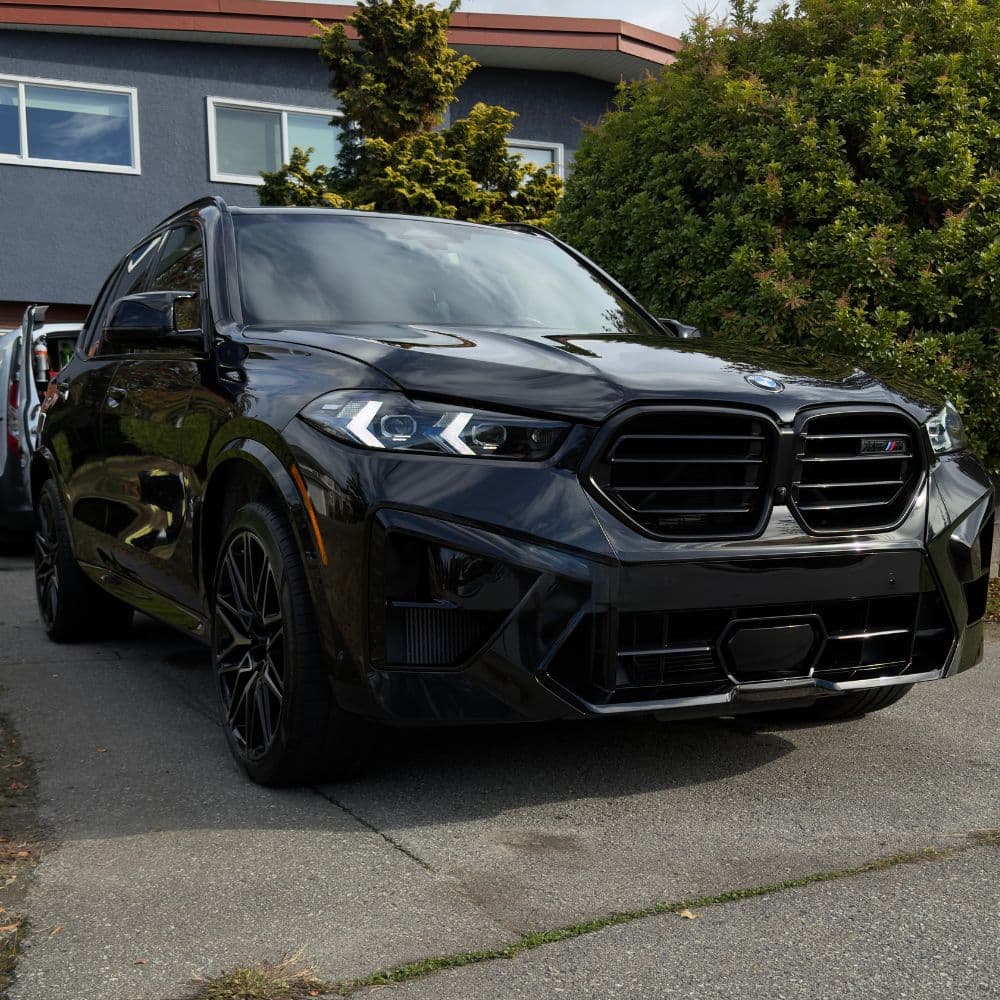
Brine lands on your hood and roof at highway speed, then evaporates and concentrates. Why horizontal panels take the damage and vertical ones don't.
If you live in Maple Ridge you drive Lougheed. Not occasionally — daily, in both directions, and usually behind a truck for some part of it. Through the winter that stretch is treated and retreated, and a fair amount of what goes down on the road ends up on your car as a fine mist thrown up by the traffic ahead of you.
Here is the part that matters, and almost nobody gets it right. Everybody checks their rocker panels and lower doors for salt, because that is where you can see dirt. But the panels taking the real cumulative damage on a highway commuter are the ones facing upward, and they look clean because the rain rinses them.
This post covers why horizontal surfaces concentrate salt rather than shed it, a paint check you can do in your own driveway in five minutes, and where a coating genuinely helps as opposed to where it is just being sold to you. Plainly first: we polish and protect clear coat. We do not repaint panels, and a coating does not repair damage that is already there.
If what you are worried about is the lower doors and rockers specifically, that is a different problem with a different mechanism, and we wrote about it separately — road salt on your lower doors covers the splash zone. This one is about everything above the beltline.
What's actually happening
- At highway speed brine comes over the car, not just up at it. The spray off the vehicle in front gets atomized and carried in the airstream, so it lands on the hood, roof, trunk lid, glass and mirror tops. The wheels throw grit at your rockers. Traffic mists your roof.
- Rain rinses the dirt and leaves the salt. Rainwater carries away the visible grime, dissolves the salt, then sits there. When the water evaporates, everything dissolved in it stays behind, more concentrated than it was before.
- Horizontal panels hold water and vertical panels drain. A door sheds a rinse in seconds. A hood and a roof hold flat puddles that sit and evaporate. Same storm, same car, completely different outcome on the two surfaces.
- The exposure is cumulative, not an event. A snow day is one heavy dose you notice and wash off. A Lougheed commute is a light dose five days a week from November to March, which nobody washes off because the car never looks dirty enough to bother.
- Salt pulls moisture back in on its own. It is hygroscopic, so a dry-looking roof with salt in the film re-wets itself every damp morning, and Metro Vancouver supplies a lot of damp mornings.
The roof is the panel nobody looks at
Most people never actually see their own roof. If you are under about six feet, you see it in reflections and at the car wash, and that is it. Meanwhile it collects more brine mist than any other panel, holds water longer, takes the most UV, and gets washed the least.
That combination is why clear coat failure on older cars tends to start on the roof and hood rather than the doors. The paint up there is not different. The exposure is worse and the inspection is nonexistent.
Where it shows up
- The hood, roof and trunk or hatch lid, which are the three panels this post is about.
- The flat shelf at the base of the windshield, where water pools against the trim and sits.
- The tops of the mirror housings and the upper door frames, which catch mist but never get wiped.
- The glass, particularly the rear window and the upper third of the windshield.
- The flat ledge above the rear bumper, which catches everything coming off the back of the car.
A five-minute paint check
Do this in daylight on a dry car. Step five is the one that proves the whole post.
- The bag test. Put a thin plastic bag over your hand, then run it lightly across the hood. Through the bag you will feel contamination your bare fingers cannot detect — it comes through as a fine sandpaper texture instead of smooth glass.
- Look at your roof properly. Stand on a step, or hold your phone above it and take a photo. Most people are genuinely surprised the first time they do this.
- Watch how water behaves. Tip some over the hood. Water that beads up and runs off means there is protection working. Water that sheets out and sits in flat patches means there is not.
- Get a low angle with a light. Crouch so you are looking across the hood rather than down at it, with a flashlight or phone torch raking across the surface. Swirls, water spotting and etching only show up at that angle.
- Compare a horizontal panel to a vertical one. Bag test the trunk lid, then the door below it. Same car, same age, same washes. On a highway commuter the trunk lid feels noticeably rougher, and that difference is the entire argument of this post in a form you can feel with your own hand.
If you only do one, do the bag test on the roof. It takes thirty seconds and it tells you more about your paint than looking at it does.
What you can do through the winter
- Rinse the horizontal panels more often than the rest of the car. A plain water rinse, no soap and no contact, removes the salt film and costs you two minutes.
- Include the roof every single time. It is the panel that gets skipped, and skipping it is how it becomes the worst surface on the car.
- Do not dry-wipe anything. Wiping dust and salt off a dry hood with a cloth is the fastest way to put swirl marks in paint, and it is extremely common.
- Clear the base of the windshield so water is not pooling against the trim all season.
- Rinse after a stretch of highway driving, not on a schedule. The car does not care what day of the week it is.
That routine keeps salt from sitting for weeks at a time. What it does not do is remove contamination already bonded into the clear coat, and it does not put protection back on paint that has lost it. The bag test and the water test tell you which of those two situations you are in.
When it needs a professional
A rinse is enough. If the water still beads and runs and the bag test comes back smooth, your paint has protection and is reasonably clean. Keep rinsing the horizontals through the winter and spend your money on something else.
It is worth coating. When the water sheets instead of beading, when the bag test is rough, and when you are driving Lougheed daily through a winter and would rather not scrub your hood twenty times to keep it clean. That last reason is the honest one, and it is addressed below.
It is past us. Clear coat that is peeling, dulled or cloudy in patches has failed, and no coating goes over failed clear coat — that is a repaint. Deep scratches through to primer, dents and rust are body shop work. Where the paint needs correcting before a coating goes on, that is paint correction, priced separately.
What a coating actually does about this
Worth being precise here, because coatings get oversold and the real benefit is more specific than what you usually read.
A coating does not stop brine landing on your car. Nothing does. What it changes is how long the salt stays in contact and how much physical effort it takes to remove.
On a coated horizontal panel, water sheets off faster rather than pooling and evaporating, and the contamination that does land releases with a rinse instead of needing to be worked at. That matters for a reason which is not obvious: most of the damage winter commuter paint suffers comes from being cleaned, not from being dirty. Every time you take a cloth or a mitt to a hood you put fine scratches in it. If a coating cuts the number of times you have to touch the paint across a winter, it is protecting the paint from you as much as from the road.
That is the case for it. It is not that the coating makes salt harmless.
What a System X® ceramic coating visit does
We come to you across Maple Ridge — Albion, Silver Valley, Cottonwood, Haney, Hammond and along Lougheed itself. Driveway, building parkade or office lot, and we bring water, equipment and lighting.
Decontamination wash first, paint correction where it is needed, then the System X® coating applied panel by panel. A full day for most vehicles, and the car stays parked afterwards while it cures.
Being mobile matters for a coating in particular. The nearest shop-only alternative is a studio in Burnaby, which means driving the car down and back — and the drive home happens during the cure window, down the highway this post is about. In your own driveway or parkade it cures where it is already parked. We covered that trade-off in full in mobile vs shop ceramic coating.
Which visit matches
| What you're seeing | Best fit |
|---|---|
| Water beads and runs, bag test smooth | Keep rinsing the horizontals — nothing needed |
| Water sheets and sits, bag test rough | System X® coating — From $1,119 |
| Daily highway commuter you want to stop scrubbing | System X® coating — From $1,119 |
| Visible swirls and etching on the hood at a low angle | Paint correction first, quoted separately |
| Grit damage on the rockers and lower doors | Different problem — see the lower doors post |
| Clear coat peeling, or dents, rust and cracked glass | Not us — repaint, body shop or glass shop |
Quick answers
How much is a ceramic coating in Maple Ridge?
From $1,119 for System X Crystal+, with Pro+, Max G+ and Phantom above it. Our ceramic coating cost guide covers what moves the price on a given vehicle.
Will a coating stop road salt damaging my paint?
It won't stop salt landing on the car. It makes it release more easily and shortens how long it sits, and it reduces how often you need to physically touch the paint to keep it clean. That second part is where most of the real protection comes from.
Should I coat the car now or wait until spring?
Now makes more sense if the car is driving a treated highway daily, because that's the exposure you're trying to shorten. Waiting until spring means getting through the whole winter unprotected and then paying to coat paint that's in worse condition.
Does my roof really need washing separately?
It needs washing at all, which it usually isn't getting. It's the panel with the worst exposure and the least attention on nearly every car.
Can you coat a car in the winter?
Yes. The coating needs to cure dry, which is why a parkade or a garage is ideal, and we work around the weather rather than waiting for it.
What moves the number on a given vehicle is covered in the ceramic coating cost guide.
How to book
- Call or text (778) 656-2947, or send a message through the contact page.
- Do the bag test on your hood and roof first, so you can tell us what you are actually feeling.
- We confirm a tier, a date and a price, and tell you honestly whether correction is needed first.
- We come to you in Maple Ridge or Pitt Meadows — driveway, parkade or office lot.
Bag test your roof tonight
Thirty seconds, a sandwich bag, and you will know more about your paint than you did this morning. If it feels like fine sandpaper, that is the winter so far.
Call or text (778) 656-2947, or get in touch. We're mobile across Maple Ridge and Pitt Meadows.